

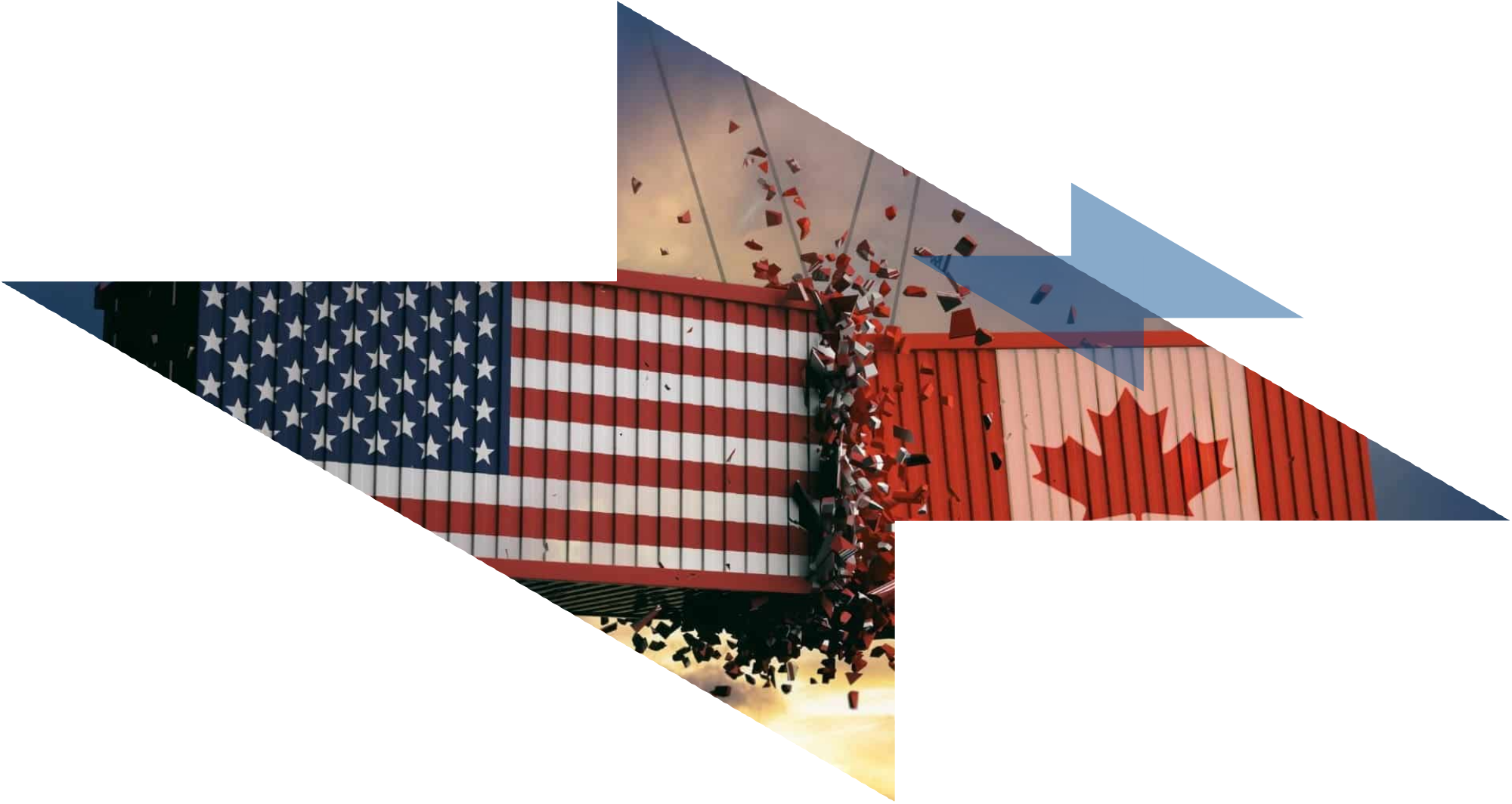
Tariff Tracker
Latest updates, industry guidance and resources related to Canada–U.S. tariffs and their potential impact on electrical contractors.
Latest New ECAO Bulletin: Most Recent Tariffs Impacting ECAO Members
On August 22, 2026, the United States imposed a 50% tariff on $27.6 billion of Canadian goods. Canada responded with counter-tariffs of 15%, 25%, or 50% on the same value of U.S. goods, effective September 8, 2026.
For electrical contractors, the impact goes beyond the tariff itself. Members may see higher material and equipment costs, shorter quote-validity periods, pricing uncertainty, longer lead times, and added risk on fixed-price work.
ECAO has prepared a new bulletin outlining where contractors may be exposed and what to do now. It covers the situation at a glance, where you may be exposed, bid and pricing uncertainty, and recommended actions at each stage — before you commit, at tender, and on awarded work.
The highest-value steps, if you do nothing else:
- Confirm line-item origin, HS classification, and importer of record
- Build an exposure register for high-value, long-lead purchases
- Lock price and lead time where justified
- Allocate tariff risk explicitly
- Protect notice rights early
- Review available support programs
In ECAO’s recent member pulse survey, 54% of responding members reported an impact already known or highly likely, and 90% identified current fixed-price projects as the most exposed work. To help us understand the impact and advocate for relief, please take a few minutes to complete the survey. One anonymized example — product, project type, cost movement — is enough. Full commercial details are not required.
ECAO Updates & Bulletins
- Canada–U.S. Tariffs Preliminary Assessment & Impact Survey — ECAO developed a Preliminary Canada–U.S. Tariff Impact Assessment for Ontario Electrical Contractors, outlining areas of potential exposure, considerations for contractors, and immediate steps members can take to manage risk. Members are also asked to complete a short survey to help ECAO build an evidence-based picture of the challenges facing contractors. Read the Preliminary Assessment | Complete the Survey
- ECAO’s Statement on Critical Infrastructure Exemption from Cost Increase — ECAO joins with CECA in calling for the exemption of tariffs, reciprocal tariffs and any other form of price escalation on critical infrastructure projects here in Ontario and throughout North America. Read More
- Statement by ECAO Executive Director, R. Graeme Aitken: Empowering Our Members with Advocacy, Education and Expert Insights — ECAO will continue to support members’ success through this latest challenge with expert communication and education, and through advocacy with government, labour and industry partners. Read More
- Tariffs — Delayed, but still looming — ECAO is closely monitoring this political battle, staying in touch with industry partners and legal resources, and continually monitoring news feeds. The reprieve on these actions may only be short-term. Read More
Industry Partner Bulletins
- CECA CECA’s Statement on Critical Infrastructure Exemption from Cost Increase — CECA strongly urges the exemption of tariffs, reciprocal tariffs and any other form of price escalation on critical infrastructure projects throughout North America. Read More
- CECA CECA’s Statement on Proposed US Tariffs — As the national voice for Canada’s electrical contracting industry, CECA addresses the unprecedented threat of tariffs on Canadian goods and their potential impacts on the Canadian electrical construction industry. Read More
- CBTU A Message from the CBTU Executive Director — Canada’s Building Trades Unions are ready to fight for members and skilled trades jobs, calling for immediate enhancements to Employment Insurance and planning for new trade infrastructure. Read More
- NECA NECA Government Affairs and Labor Relations Joint Alert: Tariffs, National Security, and the Electrical Construction Industry — NECA’s joint alert on the implications of tariffs for the electrical construction industry. Read More
- EFC EFC Tariff Survey Confirms Significant Impact — 65% of respondents anticipate that tariffs would have significant to very severe impacts to their businesses; 60% were in favour of retaliation. Read More | View full survey results
Government & Regulatory Resources
- PMO Statement by the Prime Minister on Unjustified U.S. Tariffs Against Canada — Canada responded with 25 per cent tariffs against $155 billion of American goods, starting with tariffs on $30 billion worth of goods immediately and the remaining $125 billion in 21 days’ time. Read Here
News & Media Coverage
- Financial Post Posthaste: Worried about Trump’s ‘Liberation Day’? Here’s how it might actually work in Canada’s favour — Canada and the world were shocked when Trump singled out his closest allies for tariffs in January. On April 2 the trade war is expected to widen, and that may actually help Canada. Read More
- Rubicon Strategy Premier Ford Removes Surcharge on Energy Exports — Ontario will suspend the 25% surcharge on electricity exports to the US and meet with US Secretary of Commerce Howard Lutnick to discuss a renewed USMCA trade deal. Read More
- CNBC Trump raises Canadian steel, aluminum tariffs to 50% in retaliation for Ontario energy duties — President Trump ordered tariffs on Canadian steel and aluminum raised by an additional 25%, bringing total duties to 50%, in response to Ontario’s 25% tax on electricity exports. Read More
- CBC Ontario slaps 25% levy on U.S.-bound electricity in latest trade war volley — The new levy took effect Monday and will add about $10 per megawatt-hour to the cost of power heading south, generating an estimated $300,000 to $400,000 per day. Read More
- CBC Ontario slapping 25% surcharge on U.S.-bound electricity Monday, Ford says — Ontario will charge 25 per cent more for electricity shipped to 1.5 million Americans starting Monday in response to U.S. President Donald Trump’s tariffs. Read More
- CBC Trump pausing tariffs on some Canadian goods until April 2 — U.S. President Donald Trump again paused his tariffs on some Canadian goods until April 2, offering at least a partial reprieve from a punishing 25 per cent levy. Read More
- CBC Ontario cancels $100M Starlink deal, leaving northern communities in digital limbo — Ontario’s decision to cancel its $100-million contract with Elon Musk’s Starlink has left Indigenous communities in the north questioning the government’s commitment to broadband access. Read More
- CBC Trump slaps Canadian energy exports with 10% tariffs, leaving oilpatch ‘deeply disappointed’ — Oil and gas exports from Canada are being hit with a 10 per cent tariff, while all other Canadian goods are levied at 25 per cent. Read More
- CBC How US Tariffs will likely affect Ontario industries like steel, trucking and auto — As the U.S. imposes heavy tariffs on Canadian goods — and Ottawa retaliates — many in Ontario industries like auto, steel and trucking say they’re in for a tough road ahead. Read More
- CBC Ontario rips up Starlink deal, plans to tax electricity in response to Trump trade war — Ontario will rip up its $100-million deal with Elon Musk’s Starlink and U.S. companies will be banned from procurement contracts as part of the province’s response. Read More
- CBC Trump tariffs, Canadian counter-tariffs now in effect as deadline passes — With no indication that U.S. President Donald Trump has reversed course, blanket tariffs have been imposed on Canadian goods — as has a first wave of counter-tariffs on some U.S. imports. Read More
- LinkedIn News US Tariffs Hit Canada, Mexico — U.S. tariffs on Canada and Mexico officially went into effect, with most imports from both countries now subject to 25% levies. The U.S. also doubled its trade tariffs on Chinese goods to 20%. Read More
- CBC Confused by Trump’s Many Tariff Threats? Here’s What’s Going On — Key dates to watch: March 04, March 12 and an April shower of developments. Read More
- CBC Everything You Want To Know About The Canada-U.S. Tariffs — A trade war between Canada and the United States is a complicated issue that has consequences for an untold number of people on both sides of the border. Read More
- Global News Trump tariffs are coming. Where could Canadians see layoffs first? — Economists are warning that the sweeping 25 per cent tariffs would be the “most significant trade shock” for Canada since the 1930s. Read More
- Global News What Trump’s Steel, Aluminum Tariff Threats Could Mean for Canada — U.S. President Donald Trump announced he will impose tariffs of 25 per cent on steel and aluminum against multiple countries, including Canada. Read More
- CTV News Trump steps up his 2018 tariffs on steel and aluminium, risking inflation on promise of more jobs — Trump removed the exceptions and exemptions from his 2018 tariffs on steel, meaning all steel imports will be taxed at a minimum of 25%. Read More
- Daily Commercial News Despite tariff pause, uncertainty hangs over Canadian economy — Uncertainty still hangs over the Canadian economy despite U.S. President Donald Trump announcing a 30-day pause in tariffs that were to take effect Tuesday. Read More
Legal & Expert Analysis
- Osler Trump Tariffs: President Trump Proposes New Measures on Trading Partners to Address ‘Non-Reciprocal’ Trade — The Reciprocal Trade Memo signals the United States’ intent to impose new tariffs and possibly other trade-restrictive measures on its trading partners. Read More
- Dan Leduc, Soloway Wright LLP Feb 14: Tariffs, Trade Wars, and Construction Chaos: Trying to Get a Grasp — Recording Now Available — A webinar breaking down the real-world impact of tariffs on construction pricing, contract wording and competitive pressures. Access Recording
- Osler Trump Tariffs: Second Strike Hits Steel and Aluminum — Two Executive Orders reimposing tariffs on steel and aluminum products from Canada and other countries, effective March 12, 2025. Read More
- MNP Feb 11: Webinar: Tariffs, taxes, and more trends in 2025 — A Business Owner Series webinar reviewing the impacts of U.S. tariffs and Canadian retaliatory tariffs and how affected businesses can become resilient. Register Here
- MNP Key Insights from MNP’s Tariffs, Taxes, and More Trends in 2025 Webinar — A full summary of the conversation covering previous budget measures, political scan, and tariffs and trade uncertainty. Read More
- Electrical Business Magazine Tariffs: Same issues in a different guise — The construction sector relies heavily on commodities like steel, copper, aluminum, and lumber, all of which are vulnerable to tariffs. Read More
- Osler Trump tariffs: the U.S. first strike and Canada’s retaliation — On February 1, 2025, U.S. President Trump issued an Executive Order imposing 25% tariffs on all “products of Canada,” excluding energy resources, which face 10% tariffs instead. Read More
- Norton Rose Fulbright Webinar: New US-Canada tariffs take effect February 4th — Trade law experts break down the key details of the Canadian and US tariffs and offer strategies for adapting. Register Here
Frequently Asked Questions
Start here
Q-S1 — I have a fixed-price project already under contract. What should I do?
Fixed-price tenders that have not yet locked in equipment pricing are especially vulnerable to tariff uncertainty. Review the prime contract, subcontract, purchase order, supplementary conditions, and bonding obligations for change-in-law, price-escalation, tax/tariff, substitution, allowance, cash-allowance, notice, and schedule-relief provisions. Give required notice early — even before the dollar impact is fully known. Preserve the right first, then quantify when invoices and customs documentation are available. Obtain legal advice where appropriate. Do not assume force majeure provides price relief; many clauses address delay rather than increased material cost.
Sources: ECAO Preliminary Assessment, ECAO Bulletin on Most Recent Tariffs, CCDC Bulletin 11.
Q-S2 — Which product categories carry the greatest exposure?
ECAO’s preliminary assessment identifies the following as the principal near-term exposure areas for Ontario electrical contractors:
- Electrical distribution equipment — switchgear, panelboards, breakers, controls, UPS equipment, and related electronics. Selected U.S.-made electrical equipment is subject to Canadian counter-tariffs at rates of 15%, 25%, or 50% depending on exact HS classification and country of origin. For example, insulated wire and cable ≤ 1,000V face 25%; LED luminaires face 50%. Steel- and aluminum-intensive housings may face 50% where the finished imported product falls within a covered classification.
- Steel- and aluminum-intensive systems — cable tray, strut, supports, enclosures, poles, raceways, structural mounting systems, and certain lighting components. U.S.-origin steel and aluminum products face a 50% tariff.
- Long-lead electrical gear — particularly material for large institutional, transit, data-centre, industrial, and infrastructure projects, where suppliers may respond through shorter quotation-validity periods, escalation clauses, deposit demands, allocation limits, re-pricing, or product substitutions.
- Major site or shop equipment. Tools, fleet vehicles, industrial machinery, and large site or shop equipment warrant greater diligence than commodity purchases with multiple Canadian or non-U.S. sources, particularly where the supply chain is U.S.-origin exposed.
These are screening categories, not a coverage list. Whether a specific product is covered depends on origin and HS classification. A comprehensive exposure register listing the affected items by exposure risk is in development.
Sources: ECAO Preliminary Assessment, ECAO Bulletin on Most Recent Tariffs, Canada.ca Complete List.
1. The basics
Q1.1 — What happened?
On August 22, 2026, the United States imposed a 50% tariff on $27.6 billion of Canadian-origin goods. Canada responded with counter-tariffs of 15%, 25%, or 50% on $27.6 billion of qualifying U.S.-origin imports, effective at 12:01 a.m. on September 8, 2026. Each product’s rate matches the corresponding U.S. rate. In steel and aluminum, existing Canadian counter-tariffs rose from 25% to 50%. The measures target steel and aluminum, dairy, appliances, agricultural equipment, pulp and paper, plastics, and electronics. The Government of Canada maintains the authoritative list of covered products, including tariff items, effective dates, and rates.
Sources: Canada.ca Complete List, Finance Canada Backgrounder, CCA Bulletin.
Q1.2 — Is this a blanket tariff on all electrical materials?
No. Canada’s counter-tariffs are a targeted surtax, not a blanket duty on all U.S. purchases or every product containing U.S. content. Coverage depends on two things: the country of origin and the exact HS tariff classification. Do not assume an item is covered or exempt based on broad product labels.
Sources: ECAO Preliminary Assessment, Canada.ca Complete List.
Q1.3 — Is the U.S. tariff the same as Canada’s counter-tariff?
No. The U.S. tariff applies to Canadian-origin goods entering the United States, affecting contractors through exports and cross-border work. Canada’s counter-tariff is a separate import measure on qualifying U.S.-origin goods entering Canada, affecting contractors through imported materials and equipment. Both matter to Ontario electrical contractors, but through different supply chains.
Sources: ECAO Bulletin on Most Recent Tariffs, CCA Bulletin, Canada.ca Complete List.
Q1.4 — When did the counter-tariffs take effect, and what about goods in transit?
The counter-tariffs took effect at 12:01 a.m. on September 8, 2026. The federal announcement states that U.S. goods in transit to Canada on the day the measures came into force are not subject to the counter-tariffs. Importers should keep bills of lading, shipment records, customs documentation, and other evidence showing when the goods were in transit.
Sources: CCA Bulletin, ECAO Bulletin on Most Recent Tariffs, Canada.ca Complete List.
Q1.5 — Which products are affected?
Broad categories in the official list include steel, aluminum, electrical equipment, electronics, machinery, and tools, among over 600 tariff items. Some products relevant to electrical contractors may be captured, but broad descriptions are not enough to confirm coverage. ECAO will release a separate sheet identifying tariff items and product categories most relevant to electrical contractors, based on the federal list. In the meantime, members should consult the official Government of Canada list for the definitive, up-to-date coverage details.
Sources: Canada.ca Complete List, ECAO Preliminary Assessment.
Q1.6 — How do I find the rate for a specific product?
You need two things: the exact HS tariff classification and the country of origin. Ask your supplier, the importer of record, or a customs broker for the HS code, then check it against the final counter-tariff list. Do not guess at tender time.
Sources: Canada.ca Complete List, ECAO Bulletin on Most Recent Tariffs, CBSA Memo D17-2-5.
2. Origin and classification
Q2.1 — What does “U.S.-origin” actually mean?
Origin is determined under the CUSMA country-of-origin marking rules. It is different from where the item was bought, where it shipped from, or where the company is headquartered. A product made in Mexico and bought from a U.S. distributor is not automatically U.S.-origin. For these counter-tariffs, the federal materials identify U.S.-origin goods by reference to those marking rules. The importer of record or customs broker should confirm complex cases.
Sources: CUSMA Marking Rules (SOR/94-23), ECAO Bulletin on Most Recent Tariffs, CBSA Memo D17-2-5.
Q2.2 — If I buy from a Canadian distributor, am I protected?
No. Purchasing through a Canadian distributor does not eliminate exposure. A U.S.-origin item already in a Canadian distributor’s inventory does not face a new border surtax on a later domestic sale — but the distributor may still reprice it on a replacement-cost basis or based on market conditions. Future U.S.-origin imports will attract the surtax regardless of who sells them. Origin is decisive, not supplier location.
Sources: ECAO Bulletin on Most Recent Tariffs, ECAO Preliminary Assessment.
Q2.3 — Does CUSMA eligibility exempt an item from the counter-tariff?
No. CUSMA eligibility does not itself exempt an item from the surtax. A U.S.-origin item can enter at zero ordinary CUSMA duty and still attract the Canadian counter-tariff if it is on the covered list.
Sources: ECAO Bulletin on Most Recent Tariffs, ECAO Preliminary Assessment, Canada.ca Complete List.
Q2.4 — What if my product has U.S. components but is finished elsewhere?
The result depends on the marking-origin rules and the relevant production and transformation facts — not just the component source. This is a case-by-case determination and should be confirmed by the importer of record or a customs broker, not guessed at tender time.
Sources: CUSMA Marking Rules (SOR/94-23), ECAO Bulletin on Most Recent Tariffs, CBSA Memo D17-2-5.
Q2.5 — Who determines origin and classification?
The importer of record is responsible for the accuracy of the customs declaration, including tariff classification and origin information. Suppliers and customs brokers may assist, but contractors should obtain written confirmation and should not rely on a broad product description when assessing exposure.
Sources: CBSA Memo D17-2-5, ECAO Bulletin on Most Recent Tariffs.
3. Pricing and quotes
Q3.1 — Is a 25% counter-tariff just a 25% price increase?
Not exactly. A tariff is not simply a 15%, 25%, or 50% retail-price increase. The commercial outcome depends on who imports, the value for duty, the supplier’s ability to absorb the increase, whether stock is already in Canada, and the contract chain. Do not assume a quoted price will match the tariff rate exactly.
Sources: ECAO Bulletin on Most Recent Tariffs, ECAO Preliminary Assessment.
Q3.2 — Does import GST apply on top?
Import GST is calculated on the increased import value, which includes duty and surtax. The value for duty refers to the customs value of the goods used to calculate duty and GST. Registrants can usually recover GST via input tax credits, but the timing may affect working capital.
Sources: CRA GST/HST on Imports, ECAO Bulletin on Most Recent Tariffs, CBSA Memo D17-2-5.
Q3.3 — Can my distributor reprice an existing quote?
Yes. Distributors may reprice existing quotations once tariff-paid replacement inventory arrives, or based on constrained availability and broader market conditions. Some are shortening quotation-validity periods, adding escalation clauses, or requiring deposits. A quoted price may not hold.
Sources: ECAO Preliminary Assessment, ECAO Bulletin on Most Recent Tariffs.
Q3.4 — What should I ask for in every substantial quote?
Ask for written confirmation of:
- Country of origin
- Whether the goods are covered by the September 8 surtax
- HS tariff classification
- Who is the importer of record
- Whether the price includes surtax
- The price-validity period
- The basis for any tariff adjustment
Also ask whether the quoted materials are current Canadian inventory, in transit, ordered but not imported, or future U.S.-origin imports. If you are holding an open quote, assume it may be repriced.
Sources: ECAO Bulletin on Most Recent Tariffs, ECAO Preliminary Assessment.
Q3.5 — What is CCDC Bulletin 11?
CCDC Bulletin 11 — Adjustments in Contract Price Due to Tariffs — provides guidance on contractual considerations related to tariff-driven cost changes. Check it against active agreements. It is guidance, not a substitute for contract-specific legal advice.
Sources: CCDC Bulletin 11, CCA Bulletin.
4. Contracts and recovery
Q4.1 — Does force majeure give me price relief?
Not automatically. Many force majeure clauses address delay rather than increased material cost, and some fixed-price contracts allocate ordinary market and legal-change risk to the contractor. Do not assume force majeure provides price relief.
Sources: ECAO Bulletin on Most Recent Tariffs, ECAO Preliminary Assessment, CCDC Bulletin 11.
Q4.2 — Which contract provisions might help me recover costs?
The provisions to look for are:
- Change-in-law — covers new legislation or government measures
- Price-escalation — allows adjustment for specified cost changes
- Tax/tariff — addresses duties and import measures directly
- Force majeure — covers uncontrollable events, but often only delays
- Substitution — allows approved alternatives
- Allowance / cash-allowance — covers uncertain cost items
- Notice — governs how and when you must inform the other party
- Schedule-relief — addresses time impacts
Under fixed-price contracts, recovery may not be available unless these provisions and notice requirements are engaged promptly. Reviewing the contract after the cost has been incurred is usually too late.
Sources: ECAO Preliminary Assessment, ECAO Bulletin on Most Recent Tariffs, CCDC Bulletin 11.
Q4.3 — What if I have already signed a fixed-price contract?
See Q-S1 above. Review all contract documents, give notice early, keep documentation, and obtain legal advice.
Sources: ECAO Preliminary Assessment, ECAO Bulletin on Most Recent Tariffs, CCDC Bulletin 11.
Q4.4 — What documentation should I keep?
Keep the original quote, revised quote, tariff notice, supplier-origin certificate, purchase order date, shipment record, and invoice. For any surcharge, require a documented chain showing origin, HS code, effective date, base price, surtax amount, and the portion allocated to the project. This documentation is needed both for customs compliance and to support recovery from an owner or general contractor.
Sources: ECAO Preliminary Assessment, ECAO Bulletin on Most Recent Tariffs.
5. Remission and support
Q5.1 — What is remission, and is it automatic?
Remission is an exceptional, discretionary form of relief from otherwise applicable tariffs. Finance Canada may consider requests where affected goods or inputs cannot be sourced domestically or reasonably from non-U.S. sources, or where other exceptional circumstances could cause severe adverse impacts on the Canadian economy. Requests are assessed case by case and are not guaranteed. Do not price work on the assumption that remission will be granted.
Sources: Finance Canada, ECAO Bulletin on Most Recent Tariffs.
Q5.2 — How do I apply for remission?
Only companies registered in Canada are eligible to apply. Submit your request and inquiries to remissions-remises@fin.gc.ca with “U.S. Remission” in the subject line. Include:
- Company details, including your 15-digit business number
- A detailed description of the goods and the 8-digit tariff item or items
- Volume and value of importations
- Customs documentation and invoices for tariffs already paid (for example, B3 forms)
- Evidence you cannot source from Canadian or non-U.S. suppliers, including names of companies canvassed and copies of replies
- Substantiating evidence where contractual obligations prevent alternate sourcing
- Cost and pricing information where goods are used in manufacturing
- A detailed statement of the exceptional circumstances
The full process and template are on the Finance Canada remission page. Members should begin collecting this evidence now; incomplete or retrospective records may make a request more difficult to substantiate.
Sources: Finance Canada, ECAO Bulletin on Most Recent Tariffs.
Q5.3 — Are there support programs for businesses affected by tariffs?
Yes. The federal government has announced new measures to support businesses and workers affected by tariffs. These include:
- Remission (see Q5.1–Q5.2)
- Regional Tariff Response Initiative
- Strategic Response Fund
- Large Enterprise Tariff Loan
- Worker Retention and Retraining Program (WRRP)
- Business Benefits Finder
- Duties Relief Program and Drawback Program
- Other business and employer supports
Eligibility and application processes vary by program. See the Government of Canada’s business support page for the full list and details.
Sources: Canada.ca Support, CCA Bulletin.
Q5.4 — What should the exposure register track?
List each material and equipment item by:
- Supplier
- Value
- Country of origin
- Importer of record
- HS classification
- Tariff rate
- Stock status — Canadian inventory, in transit, ordered but not imported, or future U.S.-origin import
- Price-validity date
Start with your highest-value, longest-lead purchases. The register supports procurement and contract decisions now and is the evidentiary basis for a remission request if one becomes necessary. A template is in development.
Sources: ECAO Bulletin on Most Recent Tariffs, ECAO Preliminary Assessment, Finance Canada.
6. Practical action
Q6.1 — Should I stockpile materials?
Selectively, and only where justified. Early release or purchase can make sense for identified, tariff-exposed long-lead products on secured projects. Broad speculative buying creates cash-flow, storage, obsolescence, and project-allocation problems — and a blanket inventory build is not warranted until the final product schedule is known.
Sources: ECAO Preliminary Assessment, ECAO Bulletin on Most Recent Tariffs.
Q6.2 — What should I do if a specified product becomes unavailable or materially more expensive?
Consider substitution where the specification and procurement documents permit. Prequalify Canadian (ensuring compliance with the Buy Ontario Act), non-U.S., and technically equivalent alternatives ahead of time. Evaluate:
- Technical compatibility
- Manufacturer support
- Warranty
- Service capacity
- Spare-parts availability
- Lead time
- Regulatory approvals
Any shift away from a U.S. source must preserve product approval, CSA certification, manufacturer warranty, interoperability, field-service capacity, specification compliance, and delivery commitments. Do not substitute on price alone. For public projects and owner-specified proprietary products, coordinate early with the owner.
Sources: ECAO Preliminary Assessment, ECAO Bulletin on Most Recent Tariffs, COCA Webinar on the Buy Ontario Act.
Q6.3 — How stable is this situation?
The situation remains subject to changes in tariff schedules, exclusions, customs administration, customs guidance, remission decisions, and related U.S. measures. Members should rely on the current Finance Canada and CBSA information rather than an earlier product list or informal supplier summary.
Sources: ECAO Preliminary Assessment, ECAO Bulletin on Most Recent Tariffs, Canada.ca Complete List.
Q6.4 — How often will ECAO update this FAQ?
ECAO will update as the final tariff schedule, product classifications, origin rules, exclusions, and any remission process are clarified. To help us understand the impact better and advocate for relief, please take a few moments to fill out the survey. You don’t need to include full commercial details. It only takes a few minutes: ecao.info/tariff-survey
Sources: ECAO Preliminary Assessment, ECAO Bulletin on Most Recent Tariffs.